
February 25, 2026
A Probiota Global Origin Story: Differential Bio joining CanBiocin on stage
CanBiocin and Differential Bio took the Probiota Global 2026 stage in Dublin to present a joint case study on robotics- and AI-guided media optimization for a commercial L. reuteri production strain. We shared how high-throughput experimentation and AI-driven inference translated into clear, production-relevant improvements, validated beyond small-scale screening and anchored in real process constraints and economics.

Christian Spier
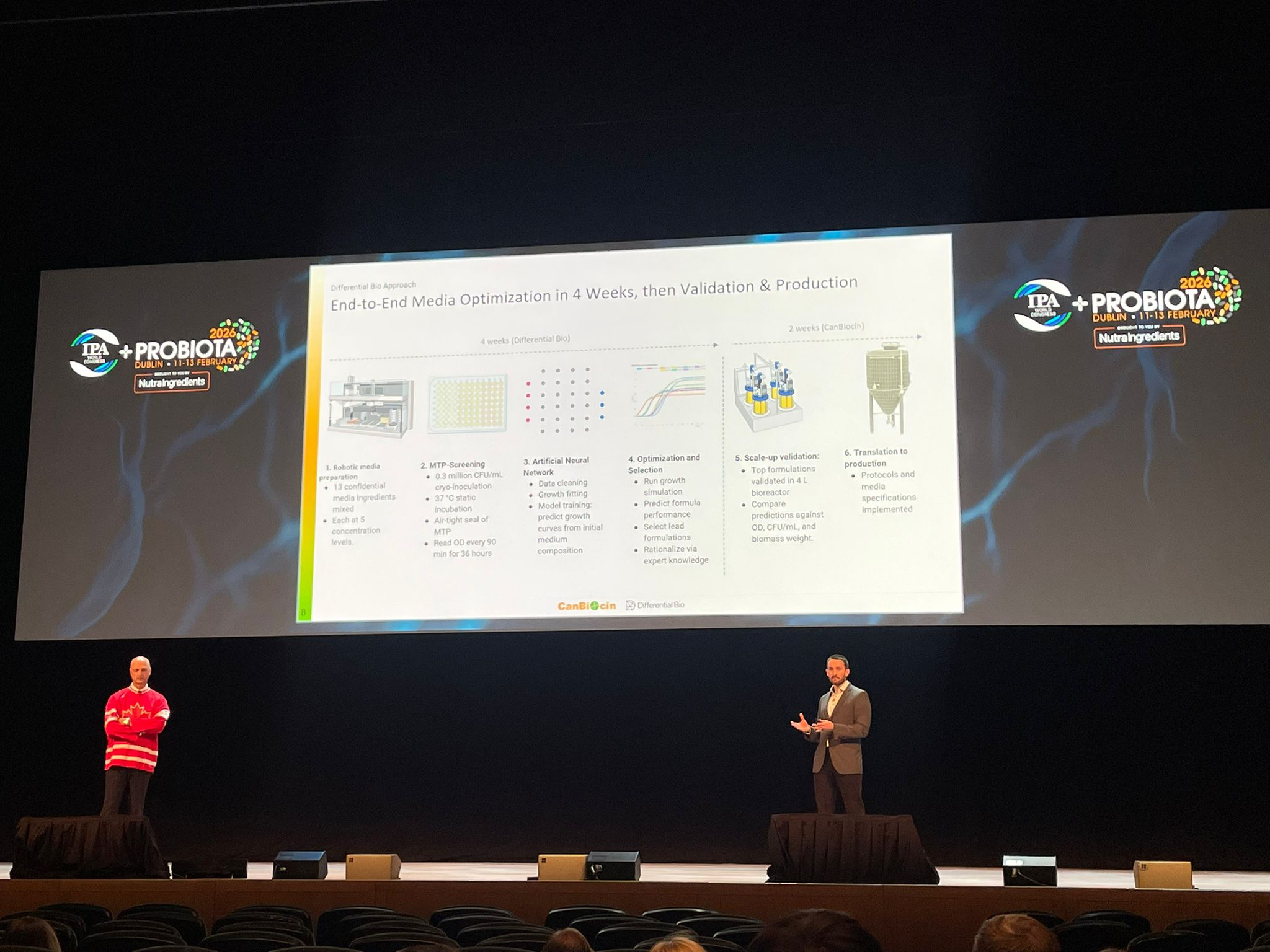
Probiota 2025 was our first time attending, and where we first met Jake Burlet and the CanBiocin team. One year later in Dublin, we found ourselves on that same stage together, presenting a case study that began with that initial conversation. We announced the collaboration in August 2025, shared early results soon after, and two weeks ago, in early February 2026, we presented the final outcomes and key insights to Probiota Global’s highly specialized audience.
The moment on the big stage
There is something distinctly different about a partner talk. It’s not the usual pitch, but rather the celebration of a shared narrative. With a subtle Olympic energy in the air (and Jake fully in ice-hockey mode on stage), our two teams combined complementary strengths to share openly what worked, what didn’t, and what others can take away. That division of roles was clear from the start:
- CanBiocin brought deep strain and application expertise (species-specific probiotics for companion animals and livestock).
- Differential Bio contributed our robotics + AI platform to run rapid, high-throughput media optimization and translate experimental data into actionable decisions.
What we presented
Our joint session centered on one core question: Can automation- and AI-guided media optimization deliver measurable impact that actually holds up in a real production context?
Based on this collaboration, the answer is: yes, but only when tightly coupled to real process constraints and economics.
Using our platform, we boosted a commercial L. reuteri strain for CanBiocin with:
- +34.1% biomass yield
- -27.6% media cost
- >3,000 formulations tested in <4 weeks
- Validated in a 4L bioreactor
- Projected break-even ≤ 3 production batches
- 283% ROI in Year 1
The biggest learning from the conference
If ML impact is tangible and tied to unit economics, companies are willing to integrate it into their probiotic development process. Not “AI for AI’s sake,” not dashboards, not vague promises, measurable gains with a clear path to cost and time savings. When that bar is met, adoption becomes much easier: teams can justify changes internally, align R&D with manufacturing realities, and move faster with confidence.
Why this matters for probiotic R&D
Probiotic development is often constrained by:
- Long iteration cycles
- High-dimensional media design space
- Scale-up uncertainty
- Weak linkage between lab optimization and manufacturing KPIs
- Limited change tolerance once a strain is in production
This case study shows how a tailored Robotics- and AI solution can reduce iteration time and increase decision confidence to scale up, especially for production strains, while staying anchored in what matters most: scale-relevant performance and business outcomes.
What’s next
We’re grateful to Probiota and the IPA for the platform and to George and the entire Probiota team for making space for industry-relevant technical stories like this. And a huge thank you to Jake and the CanBiocin team for the trust, pace, and true collaboration. After the conversations we had in Dublin, one thing is clear: there’s a lot more to come.
The core workflow, robotic high-throughput experimentation paired with AI-driven inference, translates beyond a single strain or product. Next, we’re extending the approach to additional applications to accelerate the discovery and development of new biotics (pre-, pro-, post-) across animal, human, and environmental health, aligned with a holistic One Health perspective.
Simulate smarter. Scale faster.
•More Articles
More Articles
March 26, 2025
Munich-Based AI Biotech Startup Differential Bio Emerges from Stealth with €2M Pre-Seed to Transform Biomanufacturing with Cutting-Edge Virtual Scale-up Platform

Christian Spier
February 19, 2026
Differential Bio Featured in BCG Report Linked to Germany’s Hightech Agenda as an Exemplar for Cross‑Cutting Technologies in Biotech
Christian Spier
August 28, 2025
Differential Bio and CanBiocin Publish Case Study on AI‑Driven Media Optimization for Probiotic Pet Food Ingredients
Christian Spier
Want to stay informed?


.png)
We work with you on making microbial growth predictable, scalable, and cost-effective through robotic lab automation and AI-driven insights.

